


How to Care for Artificial Eyes
Cleaning
Please do not clean it in the bathroom!
Never remove a glass ocular prosthesis over a sink or on a hard floor. There is a risk of breakage. Even a sink filled with water does not provide safe protection against glass breakage or loss down the drain.
The Right Place
Sit down at a table. Lay out a soft towel and use a plastic bowl filled with lukewarm water. We strongly advise against using water that is too hot or too cold, as extreme temperature fluctuations can affect the material’s durability. Please also do not use corrosive liquids or hard objects for cleaning.
Wash your hands
Wash your hands thoroughly before touching anything.
Removing the eye
Carefully remove the prosthetic eye over the towel and the bowl of water.
Cleaning
The glass artificial eye should be cleaned daily with lukewarm water.
For stubborn dirt, visit
. Soak the glass eye in lukewarm water or a saline solution for about 10 minutes. Then rinse the prosthesis thoroughly with clean water and dry it with tissue paper.
Insert
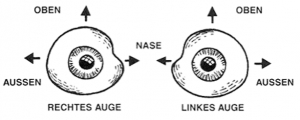
Lightly moisten the clean prosthesis to make it easier to insert. Consider the orientation of your ocular prosthesis—usually, the shorter end points toward the nose.
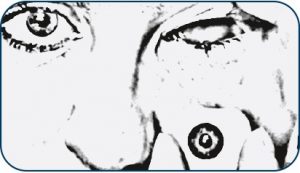
Relax your upper eyelid and lift it with your finger. Gently slide the prosthetic eye under the eyelid from the side and hold it in that position.
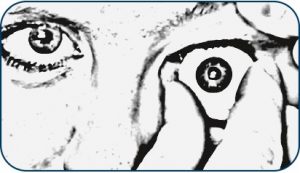
Pull down the lower eyelid and let the eye prosthesis slide behind it.
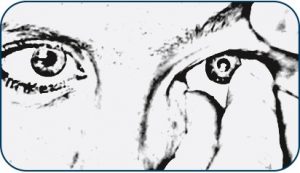
The ocular prosthesis usually settles into the correct position on its own. If necessary, it is recommended that you adjust the fit of your prosthesis by applying gentle, circular pressure with your finger to allow any trapped air to escape.
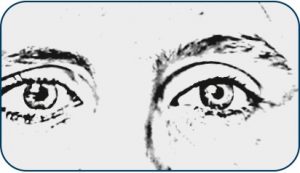
Remove
You can remove it using a special hook or a suction cup, both of which are available at our clinic.
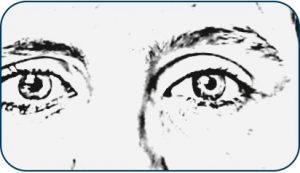

Press down on the lower eyelid until the lower edge of the denture is exposed.

Slide the tip of your index finger under the bottom edge of the denture.
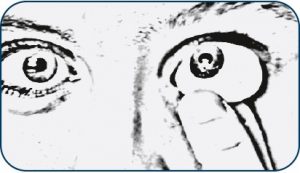
Use your middle finger to grasp the artificial eye and gently pull it downward out of the eye socket.
If you are using a suction cup, place the clean suction cup gently on the center of the prosthesis to loosen it from the lower eyelid by pulling it gently downward and forward.
Store
As a general rule, the glass artificial eye should be worn day and night.
An exception applies to the very thin bulbar scleral shell worn over a remaining eyeball: This should generally be removed at night to relieve pressure on the eyeball and allow it to receive oxygen.
It is best to store unused eye prostheses, after cleaning them, in a small, dry container. The prostheses should not be stored in water for long periods of time.
Wearing time
The average lifespan of glass ocular prostheses is 12 months ( 4–6 months for growing children).
Wear and tear
Ocular prostheses wear out on their own over time. In addition to tears, this is caused by factors such as the condition of the eye socket and incomplete eyelid closure. If the prosthesis wearer is exposed to harsh environmental conditions such as fine dust—for example, in agriculture, as a baker, or as a carpenter—the prosthesis’s lifespan may be shortened.
An increased flow of tears may be an early sign that the prosthesis needs to be replaced. If the prosthesis is not replaced in a timely manner, this can lead to significant discomfort.
Protection for both eyes
A smooth, clean contact lens prevents inflammation. It protects the sensitive tissue and ensures that your healthy eye feels completely comfortable as well.
Information for Patients
Here you’ll find all the important information and practical tips you need for the safe use of your ocular prosthesis. Our instructions will help you easily incorporate care into your daily routine.
Do you prefer reading on paper?
No problem! Our patient information is also available in print. Just ask us directly, or pick up a copy during your next office visit.